
The clearest, earliest view of how your organisation is really doing
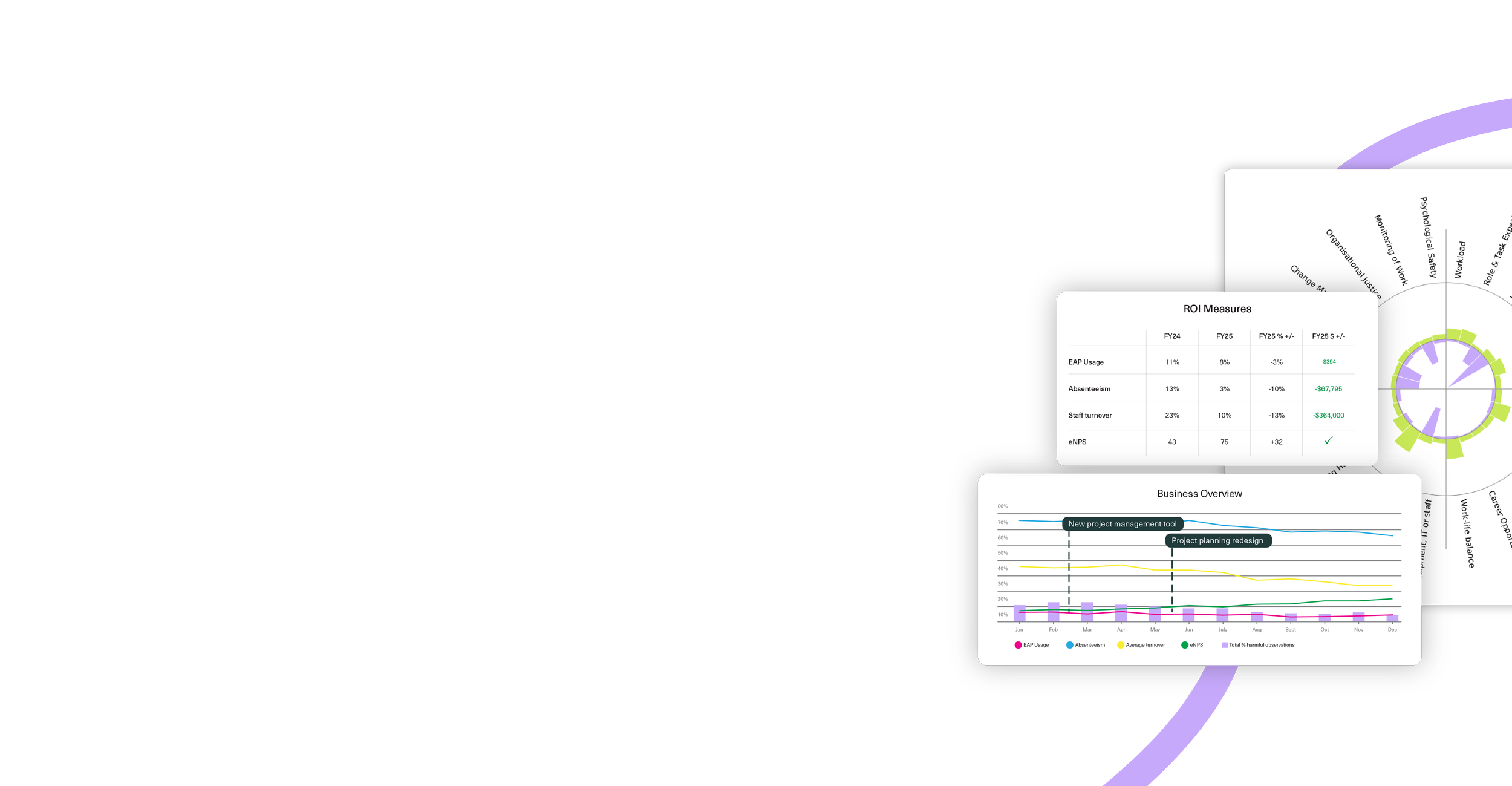
Most tools measure things after the fact. HeyPenny gives you a live, real-time view across your whole organisation, right down to the distributed and shift-based teams that are hardest to see.
By the time you find out, you're already paying for it

Most organisations only find out how work is impacting their people once it's too late to act. People have already left. Sick leave has hit an all-time high. Or a serious incident has happened. Replacing someone can cost half to double their annual salary, and most of that never had to happen. Work Institute estimates 75% of departures are preventable.

Every 1:1 becomes a data point

Leaders hold the conversation like they always would. From the transcript, HeyPenny pulls out which psychosocial factor is at play and whether it's helping someone do their best work or slowly wearing them down. On its own, that's one small insight. String enough of them together, for one person, a team, an entire organisation and they become real-time oversight that builds itself, with nothing extra for anyone to fill in.
A live window
into your organisation
HeyPenny shows you which factors are at play along with the context or story behind why they're showing up. That's what makes this a leading indicator: you see pressure building while it's still forming, instead of waiting for it to turn into a resignation or an incident. Compare a struggling team against a thriving one, watch a factor shift after a change you've made, or drill down from the whole organisation to a single site. It's the closest thing to being in every room at once.
The pilot that proved this actually works
12 Executive Leaders | 5-month pilot | 3× 1:1 check-ins
Twelve executive leaders at Capital & Coast's Department of Anaesthesia took part in a five-month pilot. Each completed three structured 1:1 conversations, run by an external organisational psychologist, with insights captured in the HeyPenny platform. For department lead Sheila, it meant a level of visibility into her senior team's health she'd never had before. It also gave her proof: a wellbeing investment she'd already made in the department showed up as one of the team's top protective factors, confirming it had actually worked. The kicker though? Every leader surveyed felt this approach could help catch pressure points earlier than the methods they'd used before.
“The pre-emptive nature is great. Fence at the top rather than ambulance at the bottom”